



The Next Biosecurity Threat Won’t Wait for Better Research Infrastructure
Why Facility Planning and Design Is a Critical Biosecurity Tool
Biosecurity preparedness depends on more than scientific expertise. It requires research infrastructure that can support the advancing technologies and increasingly interdisciplinary work required to anticipate, identify, and respond to emerging threats.
The New World Screwworm (NWS) has recently re-emerged in the US after more than 60 years of mitigation and eradication efforts. The parasitic pest threatens cattle, wildlife, and other warm-blooded animals by laying eggs in open wounds, where its larvae feed on living tissue. The pest can permanently disfigure and even kill livestock in a matter of days. According to the United States Department of Agriculture (USDA) Animal and Plant Health Inspection Service (APHIS), livestock producers in the US experienced annual losses of upwards of $100 million annually prior to the pest’s eradication a half century ago. Today, the Texas Animal Health Commission estimates the eradication of the NWS provides approximately $1 billion in direct benefits to US livestock producers and $3.7 billion in benefits to the general US economy annually.
The original eradication effort remains one of the most significant agricultural biosecurity successes of the twentieth century, relying on decades of research, large-scale sterile insect production, surveillance programs, and international coordination. But the pest’s return to the US serves as a reminder that biosecurity success is not a permanent state. Maintaining resilience requires ongoing investment in the research, monitoring, and response capabilities that support prevention efforts.
When agricultural threats like this make headlines, the conversation naturally centers on the immediate challenge. How quickly can it spread? What impact could it have? What tools do we have to respond to it?
These are critical questions. But in addition to rapid response protocols, successful prevention and eradication of pests like the NWS depends on strong commitments to maintain the specialized research infrastructure needed to study threats, develop mitigation strategies, support surveillance efforts, and advance the technologies required for future responses. Which raises the next important question:
Are the research environments supporting biosecurity research keeping pace with the challenges today’s researchers face?
Biosecurity preparedness requires specialized facilities which must be built in anticipation of, or in response to, biological threats. The original fight against the NWS depended on scientific capabilities that were advanced for their time, developed over years of research and testing. The next breakthrough in livestock health, invasive pest management, disease surveillance, or agricultural resilience will likewise emerge from the new science environments designed to support constantly evolving needs.
The Most Important Design Questions Are Not About Rooms
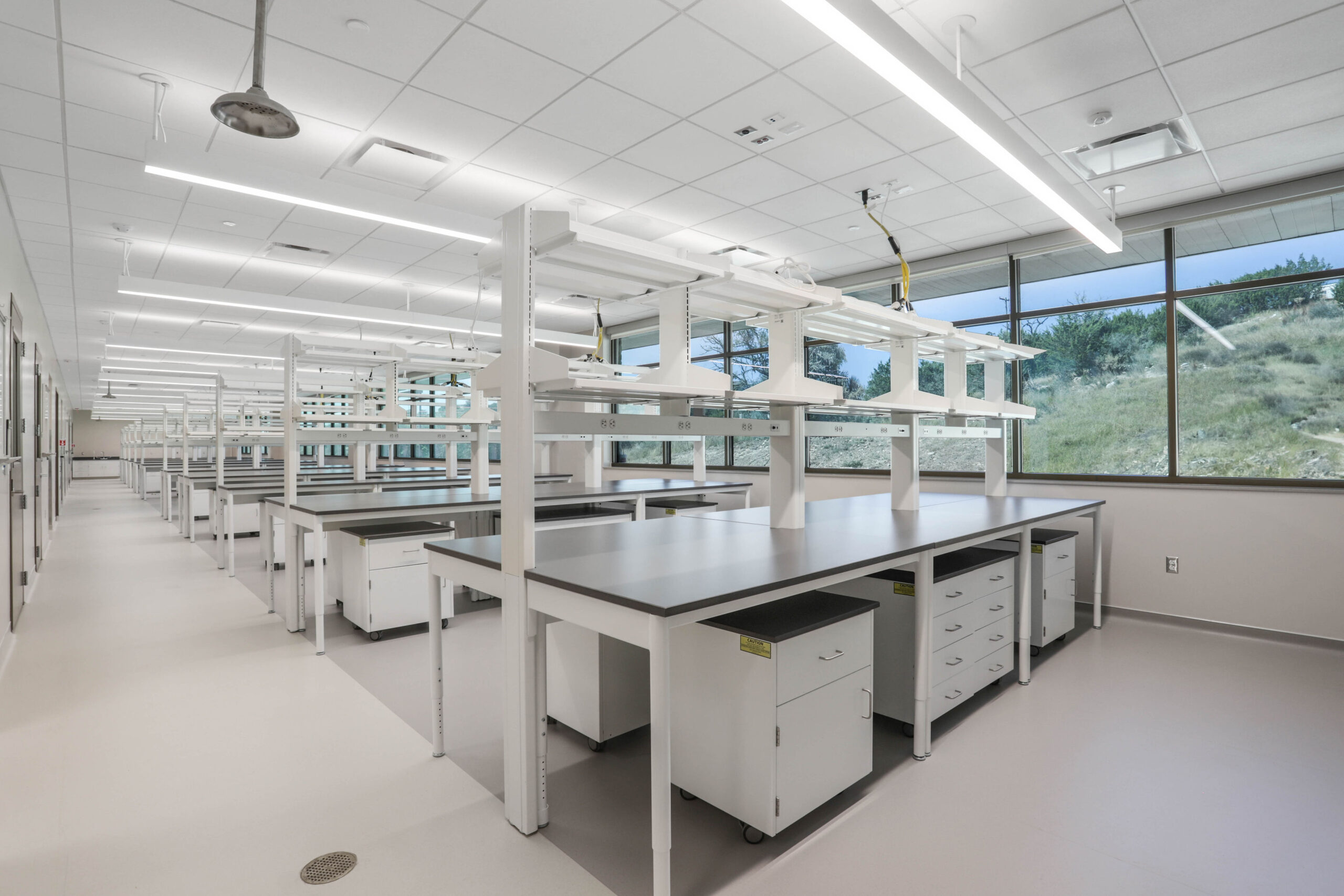
Laboratories are an essential part of biosecurity research, but they’re only one component of a larger research ecosystem that requires the seamless integration of numerous functions:
- Laboratory research
- Animal housing and handling
- Insect rearing and observation
- Sample collection and management
- Equipment support
- Data processing
- Regulatory compliance procedures
- Security and biocontainment
- Waste management
Success depends on these functions effectively working together, with their relationships and movement throughout the facility as important as the spaces themselves. The most important design questions, therefore, are not just what spaces are needed, but how research operates throughout the facility:
- How do researchers and support staff flow?
- How will animals enter, leave, and transition between environments? What support infrastructure is needed to be efficient?
- How do samples travel from collection to processing, analysis, storage, or disposal?
- Which pathways can overlap and which must remain separate? Are intersections of flows minimized or managed effectively?
- And so on…
These questions expose operational needs that a simple room inventory cannot.
A critical part of design considerations is focused on identifying what must remain separated, either by requirements or for efficient operations. Many agricultural research facilities require strict distinctions between clean incoming materials and outgoing waste streams, contained and non-contained areas, or different scientific activities operating under separate compliance requirements. These boundaries influence everything from circulation paths and access points to airlocks, pass-through chambers, decontamination spaces, autoclaves, and containment systems.
When these relationships are established early in facility planning, they can support safe, flexible, and more efficient operations. When overlooked, compromises to these relationships create costly operational limitations that can directly impact research capability and be very difficult (and costly) to resolve.
Integration and Separation ≠ Opposing Goals
Research facilities must often achieve two seemingly opposite goals:
- Encourage collaboration and interdisciplinary work.
- Maintain operational separations.
Modern biosecurity research increasingly depends on interdisciplinary teams working together to address complex problems. At the same time, many research activities require separate controlled environments, biosecurity protocols, or operational boundaries. The design challenge is to balance where integration creates value and where separation protects research integrity.
Researchers working within the same controlled zone already collaborate in their daily activities. The greater challenge is to create designs that encourage interaction among groups operating in different research areas, disciplines, or security classifications. Shared offices, conference rooms, break areas, circulation spaces, locker rooms, and other common support environments often become the places where spontaneous conversations occur, sparking collaboration among teams that might otherwise remain operationally isolated.
The primary goal, then, is not eliminating separation but creating facilities that protect scientific rigor while still intentionally encouraging the exchange of ideas.
When Facilities Become the Constraint
Discussions about research modernization tend to focus on aging buildings and deferred maintenance, which are often symptoms of budget challenges for nearly all research organizations. Temporary solutions to work around facility limitations become standard operating practice. Meanwhile, research needs and processes continue to evolve.
The threats organizations face decades from now may bear little resemblance to those that informed the design of today’s facilities. Facilities designed around yesterday’s research priorities can become barriers to adopting tomorrow’s tools.
As research programs grow, one of the most common limitations in aging facilities is infrastructure capacity. Ventilation systems, exhaust infrastructure, mechanical space, and utility capacity can become constraints on the science itself when they can’t keep up with equipment and expanding space needs. It’s vital that new facilities plan to build in a measure of future capacity, because it’s certainly disruptive—and often cost-prohibitive—to expand infrastructure systems.
An accelerating need for stronger data infrastructure presents another challenge. Modern research generates and manipulates vastly more information than it did just a decade ago. Advanced imaging systems, genomics platforms, automation technologies, and computational analysis require reliable networks, uninterrupted power, cooling, and robust data-management capabilities.
These challenges affect more than building performance. They can directly influence an organization’s ability to respond to emerging biosecurity threats. Modernization—whether through existing facility renovation or new design—creates an opportunity to ask critical questions that will help inform designs that can better support evolving scientific research needs:
- Which workflows still make sense?
- Which processes exist because of current facility limitations?
- Where are functions unnecessarily duplicated?
- Which activities would benefit from greater proximity?
- Where is the facility limiting the adoption of new tools?
These questions often reveal design opportunities that are not identifiable through a simple room inventory or building assessment, and it’s why effective programming requires more than simply documenting requests. It requires understanding the purpose behind them. A design team must ask why an activity happens in a certain way and understand whether the existing process represents a requirement or merely the best available workaround.
Practical Adaptability vs. Unlimited Flexibility
There is no universally flexible research space. A room that can accommodate different furniture arrangements is not necessarily capable of supporting new equipment. A laboratory with moveable casework may still be constrained by fixed utilities, ventilation capacity, structural limitations, containment needs, or adjacent functions. Designing for flexibility is often confused with designing for every possible outcome. However, flexibility requires understanding how scientific priorities are likely to evolve and designing facilities that will support those shifting priorities.
The objective is not maximum flexibility, it’s practical adaptability.
Meaningful flexible design begins with understanding specific scenarios. An organization might need to change research teams, replace analytical equipment, modify utility connections, adjust the balance between laboratory and support space, expand a specialized capability, or introduce a new research program. Each change requires a different response. The planning team’s job is to distinguish what should remain fixed in a facility, and what needs to adapt.
Better Facilities Reduce Friction Around the Science
Research facilities exist to make scientific discoveries. Built environments can either support that work or create obstacles that divert time, attention, and resources away from the research itself. The differences often appear in small, everyday details:
- Clear pathways for people and materials
- Efficient access to shared resources
- Well-positioned support functions
- Equipment maintenance that doesn’t disrupt research
- The ability to accommodate new programs without major renovation
Ultimately, the success of a facility is not measured by floor area, equipment counts, or the complexity of its building systems; it is measured by what researchers can accomplish.
A well-designed facility does not get in the way of doing the science.
A successful facility lets researchers spend less time working around facility limitations and more time advancing science.
Research Infrastructure is a Critical Part of Biosecurity Preparedness
The public generally encounters agricultural biosecurity only during moments of urgency: a new threat detection, an outbreak, or an eradication effort. But the research capabilities behind a possible response must be built long before a crisis emerges.
The history of the New World Screwworm demonstrates that successful biosecurity outcomes do not happen because of a single breakthrough. They are enabled by long-term investments in scientific research, operational infrastructure, surveillance programs, specialized facilities, and the ability to adapt as conditions change. The systems that supported eradication decades ago still require ongoing evolution to meet today’s challenges and prepare for those that have yet to emerge.
This makes research infrastructure a critical component of both biosecurity preparedness and agricultural resilience. The connection between the facility and the science conducted within it is becoming increasingly important as the pace of scientific advancement continues to accelerate.
Today’s researchers are adopting new technologies, analytical methods, automation tools, and data-intensive capabilities at a rate that would have been difficult to anticipate a decade ago. Technologies considered future possibilities often become operational requirements in the matter of a few years.
Unfortunately, facilities evolve much more slowly than science. A research building may remain in service for half a century, while the equipment and technologies it supports will change multiple times over that span. The infrastructure systems within these environments, such as power, ventilation, data networks, water systems, and environmental controls must be capable of supporting growth and adaptation long after a facility opens.
The New World Screwworm serves as a reminder that biosecurity preparedness is never completed. The infrastructure, expertise, and research capabilities that helped eradicate the pest decades ago still require continued investment and adaptation today. The next threat will almost certainly require different technologies, scientific approaches, and forms of collaboration than those in use today.
We can’t predict every threat. We also can’t anticipate every scientific breakthrough. What we can do is plan and design environments that give researchers the freedom to adapt, collaborate, and respond as both challenges and technologies evolve.
 Stephen Helgren, RA
Senior Architect
Related Markets: Life Sciences
Stephen “Steve” Helgren is a senior architect and laboratory planner who assists research and life sciences organizations translate scientific goals into high-performing laboratory environments. Drawing on decades of experience with universities, federal agencies, and research institutions, he specializes in planning facilities that balance safety, flexibility, and technical performance while supporting collaboration and innovation. His work focuses on guiding clients to anticipate future research needs and create laboratory spaces capable of evolving alongside scientific advancement.